Last November, I read an excellent article by Prof. Krishnaswamy VijayRaghavan, former Secretary, Department of Biotechnology, where he advocated the use of local languages in the frontier areas of science teaching to end intellectual colonialism and excel in science and technology. Although my high school science education was in Hindi medium (Our School, St Xavier’s High School, Patna, had turned Hindi medium in the late 70s), I never had an opportunity or ever thought that Hindi or any other vernacular could be used to communicate modern science principles. I got used to English since my I.Sc. days in Science College, Patna. A couple of years back, I did attempt to write a blog on NMR spectroscopy in Hindi, but that remained an isolated example until I gathered all my courage to give a science talk in Hindi.
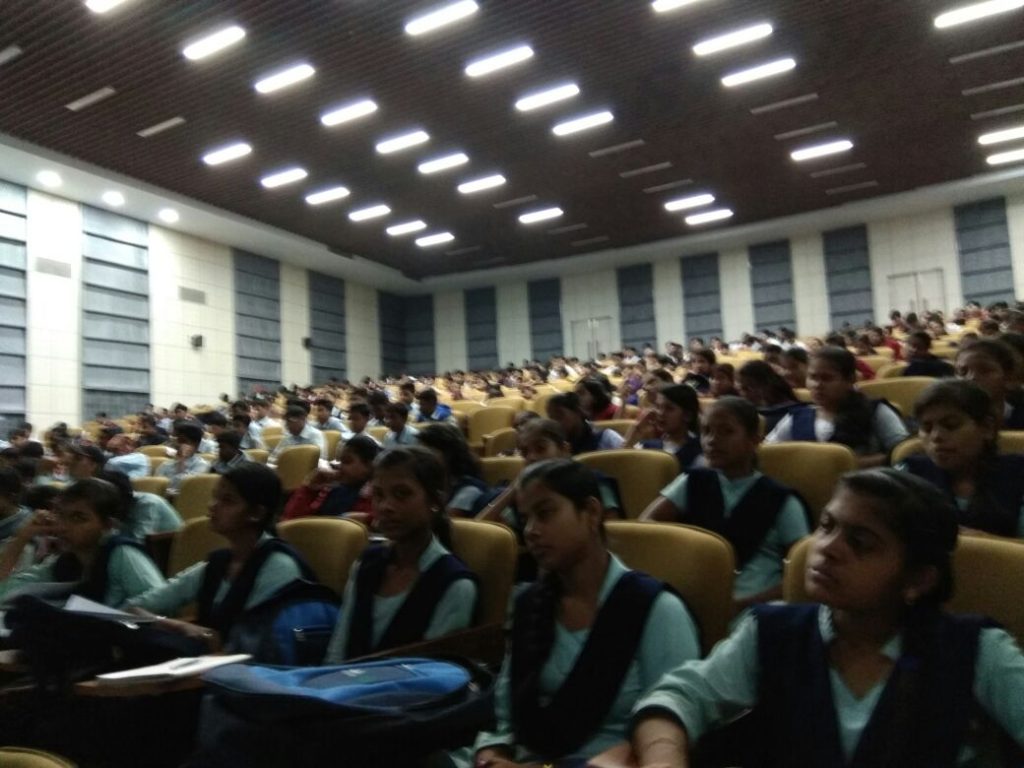
The opportunity came in the form of the DST-INSPIRE camp organized at KIIT, Bhubaneswar. As usual, I had prepared my lecture in English. As there was nothing to do before my slot, I thought of sitting in the audience and listening to a couple of lectures before me. There were about 450 school students, mostly from government schools, along with their teachers, sitting in the new hall, and many of them appeared very indifferent to the high-quality talks, some napping, some on mobile, and some chatting. At the end of the lectures, there were a couple of questions from a few agile and smart students.
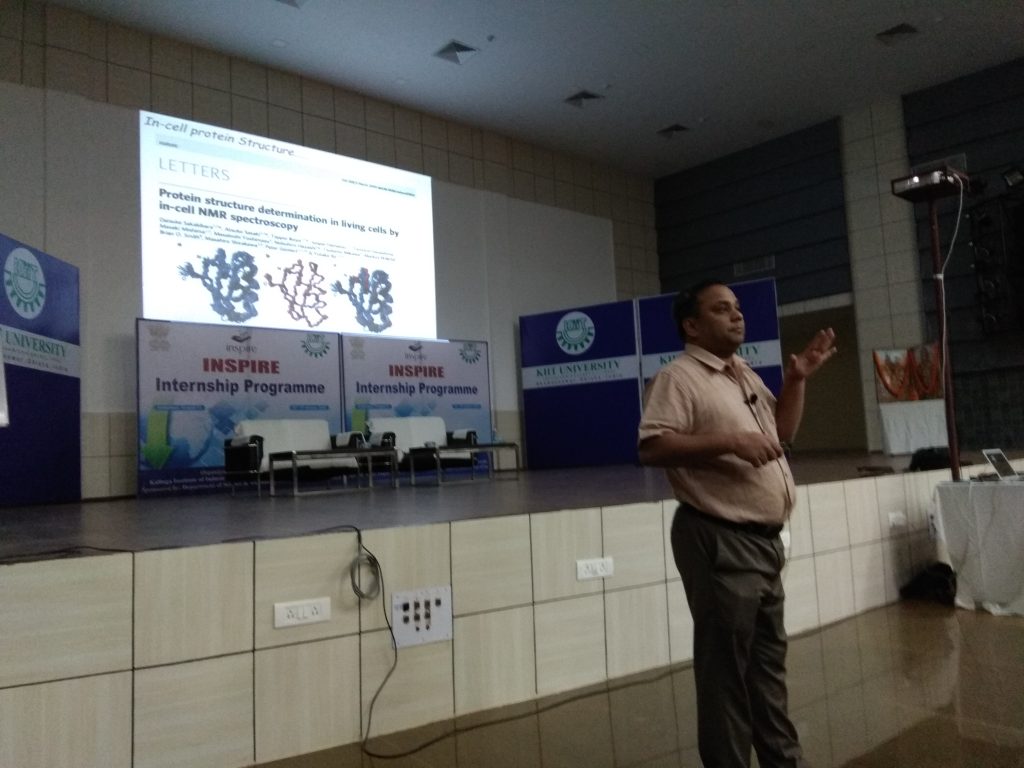
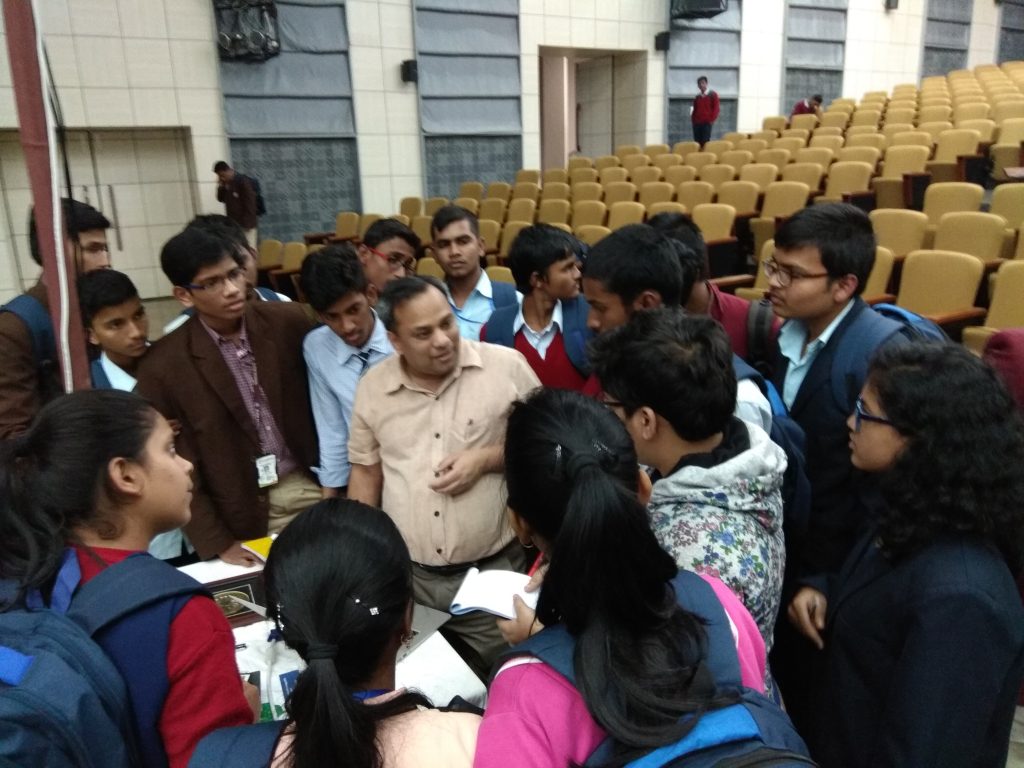
The scenario appeared to be defeating the noble aim of the program. About a decade back, the Department of Science & Technology started a series of INSPIRE programs which contained a usual design to support regular researchers. Still, more importantly, it brought a paradigm shift in how school students are mentored to develop a love for science and arouse their inquisitiveness. Then I thought of challenging myself and decided to give a talk on Structural Biology that included X-ray, NMR, and CryoEM in Hindi. Initially, I was nervous, but slowly Hindi words kept coming to my mind, and I completed my lecture smoothly. I could see awake eyes in the audience with their ears on my words, which continued to inspire me as I went through my talk. At the end of the lecture, I felt satisfied, similar to when I had written my first NMR pulse code. But there was surprise in store; I was bombarded with questions from the students, and almost all of them asked in Hindi. The question & answer session continued for another hour. The session had to be ended after I shared my email/mobile and promised to answer their question via email. I got the biggest trophy for my adventure. Then I asked whether it would have been better if I had spoken in Odiya, and I was drowned in a unanimous yeah sound. I was handicapped, I do not know Odiya, but I promised them that I would suggest to the organizers that they should organize a few talks in Odiya, which I did. There were more surprises when I returned to Delhi and opened my mailbox. There were questions from those students who wanted to know how Oxygen binds to hemoglobin. Why can proteins have many structures? etc., etc. These question-containing mails were more rewarding than the acceptance emails from journals.
The experience reminded me of the days I worked as a postdoctoral fellow at ETH Zürich. All education up to the graduation level at the ETH is in German, while its Laussane unit EPFL uses French. English is only used at the PhD level and to some extent at the Master’s level. All foreigners submitting their PhD thesis in English must write a two-page summary of their research work in either German or French. European scientists have excelled and contributed with their path-breaking innovation, which is reflected in a number of Nobel prizes bestowed upon them. One of the reasons for its success could be language. Science is taught in local languages in Asian countries like Japan, Korea, and China, too.
I have always believed that our thinking and creativity will always be in our mother tongue, no matter how good we are at other languages. During an extreme state, like fall or getting hurt, the first word to come out of one’s mouth is in one’s own vernacular. The suggestion made by Prof. VijayRaghayvan, a distinguished alumnus of TIFR, to formally start teaching students in high school in both their native language and in English has the potential to bring a much-desired positive change in the education system. If we start teaching science in Tamil, Marathi, Hindi, Magahi, and Bengali, we will create creative sparks in India. When my first Chemistry teacher, Shri P. K. Trivedi ji, had said during one of the classes (it was class 8th) that कार्बन ना लेता है, ना देता है (meaning Carbon neither takes nor gives), the concept that Carbon makes covalent bonds made a permanent home in my mind. This is the beauty of explaining concepts in the vernacular.